
Blanca Aguado-López, Ana F. Palenciano y María Ruz
Centro de Investigación Mente, Cerebro y Comportamiento, Universidad de Granada, España

(cc) Blanca Aguado.
Cognitive control is a mental function that helps to act in accordance with our goals, avoiding distractions. Proactive cognitive control prepares us to process stimuli before they appear, while reactive cognitive control improves our processing at the very moment they occur. Both mechanisms are essential and complementary in behavioral adaptation to the environment. Using neuroimaging techniques, recent studies show that different brain networks are involved in these processes.
How do you react when a car suddenly cuts you off? Or when a stop sign appears while you’re driving? And how do you know when to stop? Your brain is constantly maneuvering to adapt your behavior to what’s happening around you. This ability is called cognitive control, and it’s what allows us to adjust our actions according to our goals. When you’re driving and see a stop sign, you anticipate the intersection, reduce your speed, and finally stop right at the line. This is a case where proactive control is activated. On the other hand, if a car suddenly pulls into your lane, reactive control appears. These two ways of acting, anticipating and reacting, are part of Braver’s (2012) model, which explains how we control our behavior in changing situations.
In this way, how is this adaptive capacity studied in the laboratory? Scientists have designed experimental tasks that simulate situations similar to those we experience in our daily lives. In one of these tasks, visual cues (e.g., geometric shapes) are presented to indicate what type of information we should pay attention to. Imagine you have to decide whether a face or name belongs to a man or a woman. A shape tells you to focus only on the face, and then a face and a name are superimposed (Figure 1). If you are well-prepared, you will know that your response should be based solely on the face, just as a traffic sign tells you what to do a few meters ahead. However, even though you are told to focus only on the face, you may not be able to avoid processing the name. If the name is of a different sex, this may interfere with the processing of the face and activate reactive control.
This type of task allows us to study both proactive and reactive control. To study proactive control, we can modify the timing of the preparatory cue presentation. The longer the interval, the more anticipatory adjustment for the task is enhanced. Conversely, to study reactive control, we can modify the characteristics of the presented stimuli, for example, whether the face and name appear together or separately, or whether the stimuli are of different sex, thus requiring greater reactive control.
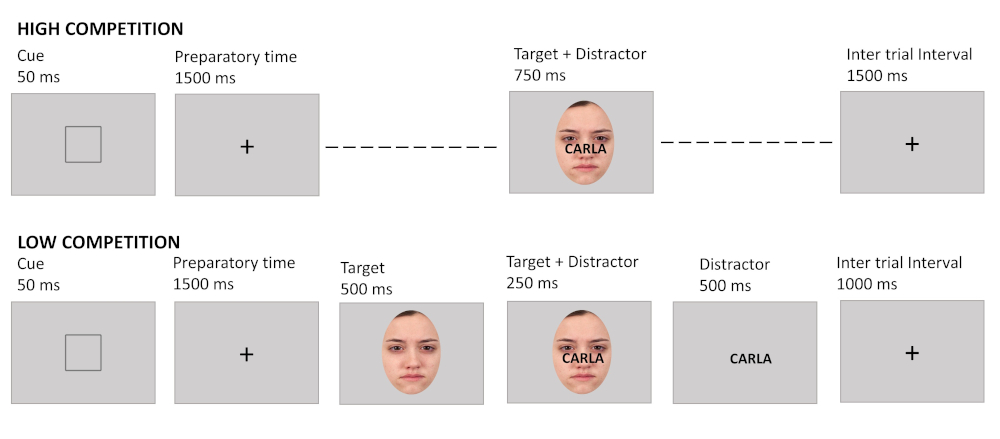
Figure 1. Experimental paradigm with anticipatory cues (a square) and different presentations of the target stimulus (e.g., target). The task consists of indicating the sex of the target stimulus. In both competition conditions, a cue (the square) is presented indicating which stimulus the participant should respond to, thus promoting proactive control. In the high-competition condition, the target and the distractor appear simultaneously; when they differ in sex, interference increases, requiring greater reactive control. In contrast, in the low-competition condition, the target is initially presented alone, without interference, reducing the demand for reactive control. It is expected that, in the high-competition condition, accuracy will decrease and reaction times will be longer due to the increased interference (adapted from Aguado-López et al., 2024).
When behavior is measured, what is observed is the final result: the action the person performs (in our example, the response of stating the sex of the stimulus). But behind this observable behavior lies a sequence of invisible steps, of which we are not usually aware. To understand what happens in the brain before we give a response, techniques such as electroencephalography (EEG) and functional magnetic resonance imaging (fMRI) are used. Studies published to date have revealed that the lateral prefrontal cortex plays a key role in cognitive control (Braver et al., 2012), but it does not work alone. It is part of a larger network known as the multiple demand network (MDN; Duncan, 2010), which includes frontoparietal regions and is divided into two subnetworks based on their activity over time: the cingulate-opercular subnetwork and the frontoparietal subnetwork (Dosenbach et al., 2008), each associated with a type of control (Figure 2).
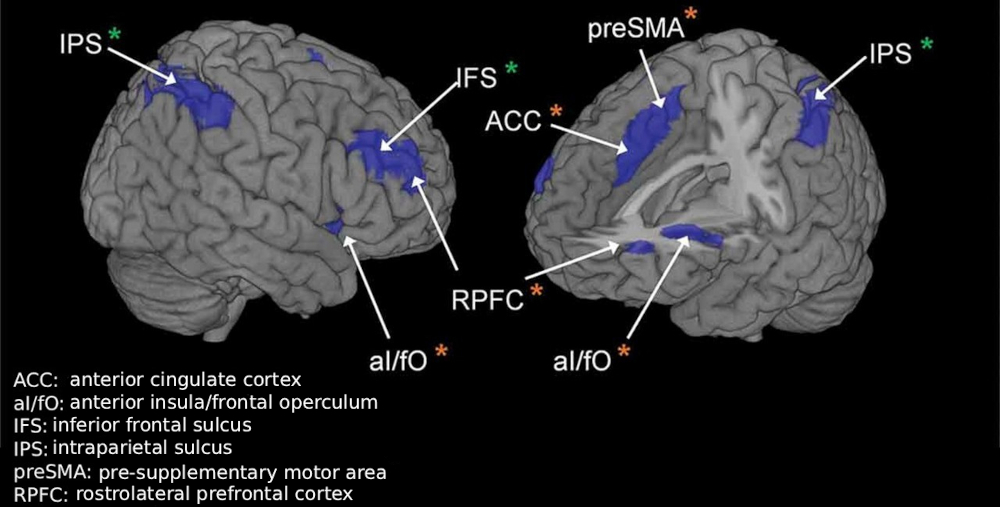
Figure 2. Regions of the multiple demand network. Orange asterisks indicate regions of the Cingulate-Opercular subnetwork associated with proactive control, and green asterisks indicate regions of the Fronto-Parietal subnetwork associated with reactive control. Adapted from Palenciano et al. (2017).
To fully understand how these two types of control are activated, it is crucial to combine techniques that tell us when it occurs (such as EEG) and where it occurs (such as fMRI). To study what kind of information the brain is processing, machine learning-inspired analysis techniques can be used, such as multivariate pattern analysis (MVPA; Haxby, 2012; see González-García et al., 2012). These analyses examine the spatial distribution of activation patterns, allowing researchers to identify what kind of information is encoded over time in different brain regions and how it relates to proactive and reactive control mechanisms.
EEG studies have revealed when the brain prepares for a task. If the cue indicates that we should focus on a face, the brain begins to represent that category even before the stimulus appears (Peñalver et al., 2023), even when we prepare knowing that it will be accompanied by another stimulus that acts as a distraction (Aguado-López et al., 2024). Furthermore, when the target stimulus is already present, the brain more clearly represents the relevant features (those we should pay attention to) than those we should ignore (Hall-McMaster et al., 2019). For example, if the face and name appear superimposed, when attending to the face, it will be represented in the brain more accurately.
In short, our brain is like an expert driver who efficiently combines anticipation with reaction. Whether we see a traffic sign or avoid a car that suddenly appears, we are activating cognitive control mechanisms. Thanks to research in cognitive neuroscience, we now know that these processes depend on specialized brain networks that activate by representing information at key moments to respond effectively.
References
Aguado-López, B., et al. (2024). Proactive selective attention across competition contexts. Cortex, 176, 113-128.
Braver, T. S. (2012). The variable nature of cognitive control: a dual mechanisms framework. Trends in Cognitive Sciences, 16, 106-113.
Dosenbach, N. U., et al. (2008). A dual-networks architecture of top-down control. Trends in Cognitive Sciences, 12, 99-105.
Duncan, J. (2010). The multiple-demand (MD) system of the primate brain: mental programs for intelligent behaviour. Trends in Cognitive Sciences, 14, 172-179.
Hall-McMaster, S., et al. (2019). Reward boosts neural coding of task rules to optimize cognitive flexibility. Journal of Neuroscience, 39, 8549-8561.
Haxby, J. V. (2012). Multivariate pattern analysis of fMRI: the early beginnings. Neuroimage, 62, 852-855.
Palenciano, A. F., et al. (2017). Neural mechanisms of cognitive control/Mecanismos neurales de control cognitivo. Studies in Psychology, 38, 311-337.
Peñalver, J. M., et al. (2023). Top-down specific preparatory activations for selective attention and perceptual expectations. NeuroImage, 271, 119960.
Acknowledgements: Becas SEPEX para la Difusión de Trabajos de Investigación 2023-2024 to Blanca Aguado-López.
Manuscript received on July 16th, 2025.
Accepted on June 25th, 2026.
This is the English version of
Aguado-López, B., Palenciano, A. F., y Ruz, M. (2026). Entendiendo el control cognitivo: ¿cómo se prepara y actúa el cerebro? Ciencia Cognitiva, 20:3, 59-62.
