Lucía Manso-Ortega (1) y Jennifer Balade-González (2)
(1) Dept. de Lengua Vasca y Comunicación, Universidad del País Vasco, España
(2) Dept. de Psicología Cognitiva, Social y Organizacional, Universidad de La Laguna, España
(cc) Lucía Manso.
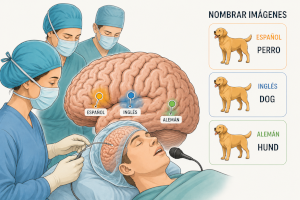
When a brain tumor grows near language areas in a multilingual patient, surgery goes beyond a mere medical procedure. Direct cortical electrostimulation mapping allows surgeons to build, in real time and with the patient awake, a unique functional map for each brain. Research shows that in multilingual brains, each language occupies partially distinct cortical areas, meaning that evaluating only one language during surgery may preserve one while irreversibly damaging another. Protecting a patient’s full linguistic identity requires detailed preoperative planning and multidisciplinary teams, because losing a language is not just losing words.