
Ismael Gutiérrez-Cordero (1,2,3) y Javier García-Orza (2,3)
(1) Unidad de Neurociencia Cognitiva y Afasias, Centro de Investigaciones Médico-Sanitarias (CIMES), Universidad de Málaga, España
(2) Laboratorio de Cognición Numérica, Universidad de Málaga, España
(3) Departamento de Psicología Básica, Universidad de Málaga, España

(unsplash) bert-b.
The study of speech errors provides valuable insights into the functioning of our cognitive system. Several studies with brain-damaged individuals have identified a different pattern of errors in the oral production of words and numbers, which has led to the proposal of independent mechanisms for processing these types of stimuli. In a recent study, we evaluated the production of numerical and non-numerical words under strict experimental control and found similar error patterns for both types of stimuli. Therefore, it does not appear necessary to postulate separate systems for the production of words and numbers.
It is relatively normal for people to make occasional errors when speaking. Who has not, at some point, said “spoon” when they meant “fork,” or “kitchen” instead of “chicken”? In individuals with aphasia, a language disorder caused by brain damage, these errors are much more frequent and directly affect their ability to produce words and, therefore, to communicate effectively.
The errors produced by people with aphasia can be of different types, and they are thought to originate in relatively specific areas of the cognitive system and the brain. In fact, these errors tend to be fairly stable because they are determined by the location of the lesion. For example, patients with damage to the ventral language pathway often show impairments at the lexical level, which includes the representations of known words, or at the semantic level, which includes their meanings. This can lead them to produce, among others, semantic errors, such as saying “dog” instead of “cat.” In contrast, when the lesion affects the dorsal language pathway, the difficulties are typically related to phonological processing, especially at the phonemic level, where phonemes are selected, ordered, and maintained during speech production. This results in phonemic errors, such as “tebra” instead of “zebra.”
However, a paradoxical phenomenon has been observed in patients with phonological deficits: the Stimulus Type Effect on Phonological and Semantic errors, known as STEPS (Dotan and Friedmann, 2015). These patients mainly produce phonemic errors, such as saying “tebra,” when they are assessed in production tasks that include nouns or verbs. Unexpectedly, however, when producing numbers, they tend to generate a higher proportion of semantic errors than phonemic errors, for example saying “thirteen” instead of “forty-two.” This reversal of their usual error pattern does not readily align with the idea that their primary difficulty lies in phonological processing. It is a challenging phenomenon to account for and it has sparked considerable debate within the field of cognitive neuropsychology in recent years. Some researchers have even proposed that the oral production of numbers engages specific systems that are partly independent of those involved in producing non-numerical words.
A few years ago, we proposed that it might not be necessary to develop alternative models that separate the production of words and numbers (García-Orza et al., 2020). Instead, the STEPS effect could be due to the lack of adequate experimental control. Unlike non-numerical words typically used for comparison, numbers (a) have especially high frequency of use, which could protect them against the phonemic errors that are common in these patients; (b) are often presented as multi-digit sequences, which are naturally longer than words (for example, “one hundred forty-seven” compared to “umbrella”), making it harder to keep their phonological trace active in memory; and (c) are presented in lists composed entirely of items from the same semantic category—that is, other numbers—unlike lists of non-numerical words, which usually include items from a range of different categories such as animals, countries, or tools. As shown in the literature, this can increase the likelihood of producing semantic errors.
Recently, we tested this hypothesis (Gutiérrez-Cordero and García-Orza, 2025). Our aim was to investigate whether the higher proportion of semantic errors observed with numbers in the STEPS effect could also be found with other types of words, by replicating as closely as possible the conditions under which number production is typically assessed. Colors, like numbers, belong to a specific semantic category, so we built sequences of color words that were analogous to multi-digit numbers. For example, as an equivalent to “three hundred fifty-six,” we used sequences of frequent colors such as “red–green–pink.” In this way, we ensured that the sequences had a comparable length and similar memory demands. As in the classic studies, we presented blocks of color sequences and blocks of multi-digit numbers, using sixty sequences in each condition. Figure 1 shows the performance of our two patients with aphasia. The error pattern previously observed with numbers was also replicated with colors: in different production tasks, both patients produced more semantic errors, such as saying “blue” instead of “green,” than phonemic errors, such as “breen.”
We then analyzed the role of lexical frequency. Our hypothesis was that phonemic errors are not produced with numbers because their extremely high frequency protects them. Previous research has shown that a frequent word like “old” tends to produce fewer phonemic errors than a less frequent word like “ancient”. To test our hypothesis, we created sequences using low-frequency colors, such as “beige–maroon–ochre,” and found that this substantially increased the production of phonemic errors, such as “beige–marone–ochre” (see Figure 1). These results confirmed our hypothesis: in numbers and high-frequency colors, phonemic errors were practically absent, whereas in low-frequency colors, they increased significantly. Lexical frequency showed a clear modulatory effect on error production.
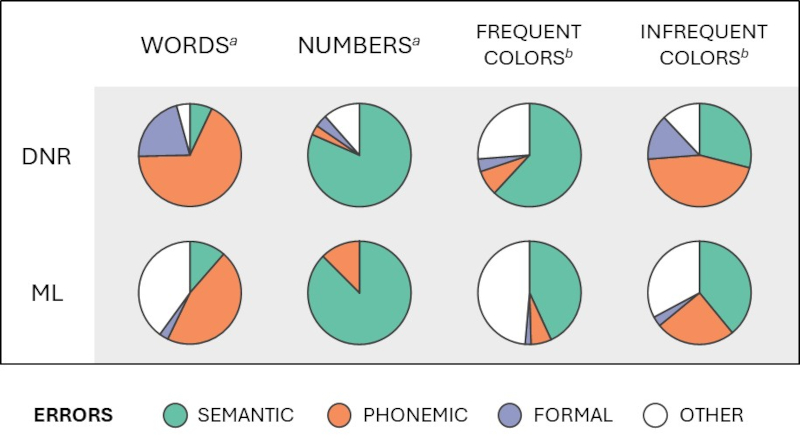
Figure 1. Proportion of error types according to stimulus type. A filled pie chart represents the total number of errors produced by two patients (DNR and ML) with different subtypes of conduction aphasia (characterized by phonological impairment). a) Data adapted from García-Orza et al. (2020). b) Data adapted from Gutiérrez-Cordero and García-Orza (2025).
Our findings illustrate how insufficient experimental control can create behavioral patterns that obscure the understanding of the cognitive mechanisms underlying language production and mask the true nature of the cognitive and neural alterations present in patients with aphasia. In the case of the STEPS effect, patients appear to show a category-specific pattern—producing more semantic errors when naming numbers and more phonemic errors when naming other types of words. However, this apparent dissociation is artificial, as it likely results from differences in how the stimuli were selected and presented, rather than reflecting genuinely distinct cognitive processes involved in producing numbers and words. When experimental variables are carefully controlled, it becomes clear that both types of stimuli engage the same underlying linguistic mechanisms.
The next time you find yourself making a speech error, remember that, just like accurate speech, our mistakes also arise from the orchestrated work of multiple processes shaped by a wide range of variables.
References
Dotan, D., & Friedmann, N. (2015). Steps towards understanding the phonological output buffer and its role in the production of numbers, morphemes, and function words. Cortex, 63, 317–351.
García-Orza, J., Gutiérrez-Cordero, I., & Guandalini, M. (2020). Saying thirteen instead of forty-two but saying lale instead of tale: Is number production special? Cortex, 128, 281–296.
Gutiérrez-Cordero, I., & García-Orza, J. (2025). Disassembling an experimental artifact in aphasia: Why phonemic errors with words and semantic errors with numbers? Cortex, 185, 184-210.
Manuscript received on March 31st, 2025.
Accepted on June 25th, 2025.
This is the English version of
Gutiérrez-Cordero, I., y García-Orza, J. (2025). ¿Es igual decir “manzana” que “veintiséis”? Lo que los errores del habla en la afasia nos revelan sobre los mecanismos del lenguaje. Ciencia Cognitiva, 19:2, 71-74.
